

Stories Matter: Writing a Testimony That Points to Jesus
5 minute read
Many Christians panic when the topic of evangelism is raised. There’s often a fear that detailed theology or apologetics will be expected. Yet one of the most valuable tools we have when speaking to unbelievers is far simpler: our own story of faith, our testimony.
Outside of the courtroom, the language of testimony is fairly unique to Christians. It can sound formal, or even intimidating. Helen Roseveare captures this well in her biography Give Me This Mountain (now compiled into Helen Roseveare A Life in Her Own Words), as she describes her first experience of the term:
“Our leader opened the meeting for testimonies. I didn't know what she meant by a ‘testimony’ so I waited... She made another attempt to get us talking by pointing out what a blessing it could be to testify to others... ‘Well, hasn't anyone anything to tell of what God has done for her during the week?’”
A dictionary defines testimony as personal or documentary evidence in support of a fact or statement.
Every Christian has a unique and powerful story of how Jesus has saved them and how God is at work in their life. And yet many believers have never shared their testimony, or perhaps shared it just once, many years ago, soon after becoming a Christian.
Are we missing out on a vital evangelistic tool?
In John’s letter we read, “We proclaim to you what we have seen and heard” (1 John 1:3). John is testifying to his relationship with Jesus. Have you thought recently about how you might proclaim what you have seen and heard? How is, and has, God been at work in your life?
Let us encourage you to take time to prepare yourself to share your story: the evidence, as it were, for your faith.
Where to Start?
Your testimony may be about your life, but its purpose is to showcase Jesus, not you.
There are no hard and fast rules for sharing a testimony. Each of us has a unique story, after all. But most testimonies share common elements, and having a simple structure can help us speak clearly and confidently. In Acts 26, Paul gives a clear, structured testimony that highlights some key components:
Background (Acts 26:2–3)
Life before Jesus (Acts 26:4–11)
Coming to faith (Acts 26:12–20)
The difference Jesus has made (Acts 26:21–26)
Final thoughts or plea (Acts 26:27–29)
I like to picture this structure as a hand, especially because there’s always one nearby!
When you look at your hand, the middle finger is usually the tallest, with two medium fingers on either side, and two shorter ones on the outside. This reflects the shape of a good testimony: short, medium, long, medium, short. Let’s look at these five sections in turn.

This may feel daunting at first, but once you’ve thought it through, you’ll find it much easier to drop into different parts of your story during conversation (more on that later!). The words you use and the level of detail you include will vary depending on your audience. Are you speaking to an individual or a crowd? Are they familiar with you, or are they strangers?
1. About You – Short
If you’re talking with people who know you well, you may choose to skip this section. But when speaking to those who don’t know you, this brief background can be very helpful. Did you grow up in a Christian home, another religion, or with no faith at all? Are there family circumstances that shaped you?
You can also mention your current job or family situation. This helps people see that you are an ordinary, everyday person, not someone unrelatable.
2. Life Before Jesus – Medium
“For all have sinned and fall short of the glory of God” (Romans 3:23).
For some, life before Jesus was chaotic or obviously broken. For others, it looked respectable and successful on the surface. But what we all have in common is that we were focused on things other than God.
What drove you? What were your priorities? What were you hoping would bring satisfaction or meaning?
If you became a Christian at a young age, this section may be brief. Still, we are all aware of the reality of a sinful heart. Sharing honestly helps set the context for what Jesus has done, while being careful not to glorify sinful behaviour.
3. Coming to Faith – Longest
What circumstances led you to consider Christianity? Did someone explain the gospel to you? What changed in your thinking?
For some people, like Paul, their conversion is marked by a specific moment in time. Others experience a gradual journey and can’t pinpoint an exact date, but they know real change has taken place.
Evangelist Roger Carswell encourages us to include the core truths of the gospel when speaking about coming to faith:
“Acknowledging that you had sinned against God,
Believing that Jesus had died paying for your sin,
Believing that He has risen from the dead and that He called you to repent and believe to receive forgiveness of sin.”
This section is vital. Without it, people may confuse becoming a Christian with simply “finding religion,” rather than responding to Jesus in saving faith.
4. The Difference Jesus Has Made – Medium
How has your life changed since coming to faith?
Not everyone’s story looks dramatic. Some sins are overcome quickly; others take time or remain lifelong struggles. Explaining the role of the Holy Spirit helps avoid the impression that we have simply improved ourselves.
You may wish to talk about changes of heart. New desires, new motivations, or how God has helped you walk through difficult seasons. It’s also important to highlight that salvation is not something we earn, but a gift of God, “so that no one may boast” (Ephesians 2:8–9).
5. Final Thoughts or Plea – Short
You may wish to close with a thought about your hope of heaven, a Bible verse that has helped you, or a gentle encouragement for listeners to explore these things themselves.
Try to finish by keeping the conversation open, offering to talk further, or perhaps giving someone a Bible or tract to take away.
Practice Makes Progress
Many people assume they could share a short testimony without preparation. Yet when put on the spot, it’s often harder than expected to know what to say, or how much to say.
Why not set aside an hour to work through these five sections? When you’re done read it aloud and see what feels natural. Ask a trusted Christian friend to take a read, or listen to you share it and offer feedback: Is it clear? Is anything missing or unnecessary?
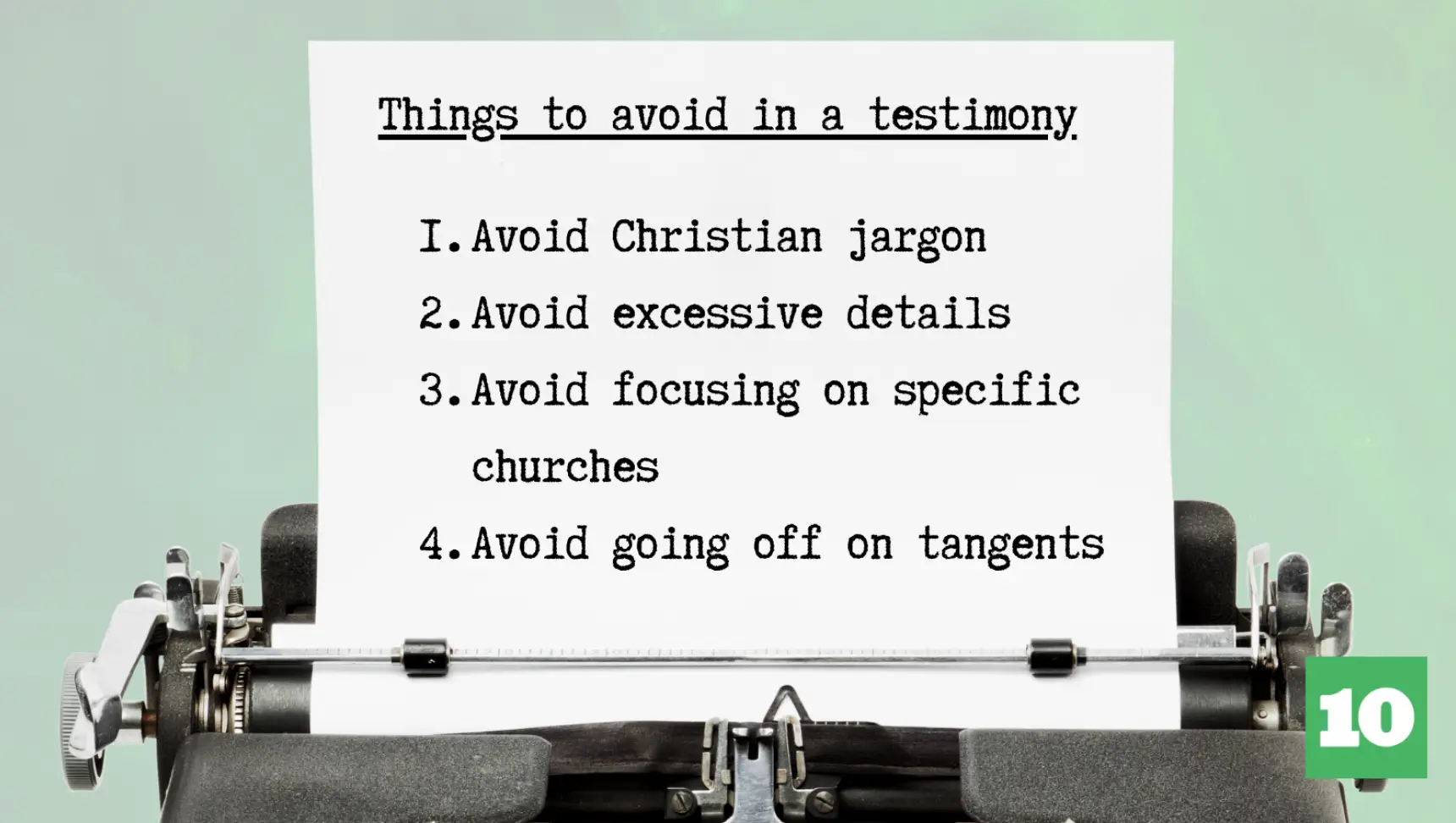
Things to Avoid
Avoid Christian jargon. Words familiar to Christians may be confusing to others. Where possible, rephrase or explain terms clearly.
Avoid excessive names and places. Details that don’t add to the story can be distracting. “A friend from work invited me along to an event” is often enough.
Avoid focusing on specific churches or denominations.
Avoid going off on tangents. Writing things out and practising will really help.
When Should I Share My Testimony?
Once you’ve written and refined your testimony, you may wonder when you’ll actually use it. Sharing your story doesn’t have to happen at a special event, even though those can be great opportunities.
You might share your testimony on social media, if appropriate, either written or recorded. More often, the opportunity will come through everyday conversations. Pray regularly for chances to share your faith. Show genuine interest in people, and look for common ground. (You might find it helpful to take a look at Things We All Have in Common and Have You Ever Wondered for conversation starters ideas.)
Some possible sentence openers include:
“I struggled with something similar, but my life changed when…”
“That actually reminds me of something I learned through my faith. Would you mind if I shared?”
“Have you ever wondered why we all long for…?”
Why are testimonies important?
Because your story matters, and because it points beyond you, to Jesus.
Your next read:
Sharing the Gospel One Conversation at a time - 4 min read
Evangelism for the Discouraged and Disheartened - 5 min read
Using tracts in Evangelism - 6 min read